1910s
Several improvements to the automobile during the 1910s made the vehicles a little more "user friendly." Many of the special extra features offered in the previous decade - convertible top, windshield, headlamps, and speedometer - now came standard with the automobile. Safety was improved as well. In 1910, front doors were introduced, the one-man canopy top (a strong canopy that covers both the front and back seat) was standard, and the first all steel body was manufactured. In 1915, a winter canopy top was available, which was solid and featured detachable glass sides. Most cars were still designed to be open, having convertible canopy tops; enclosed cars were significantly more expensive. Other changes in design included the addition of radiator grilles, spare tires carried along the running board, and a hood with rounded panels.
Note in the image below the addition of the front door and windshield and the rounded hood.
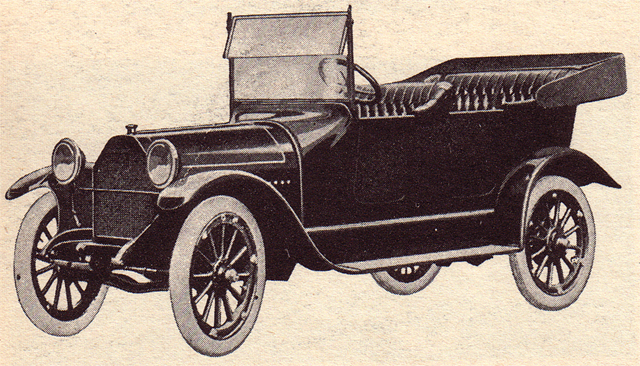
Typical 1910s Automobile: Image courtesy of Philip Van Doren, A Pictorial History of the Automobile, 1953.
The automobile in the image below demonstrates the use of the one-man canopy top. It extends over the front and back seats and is fixed rigidly with side braces.
Automobile with One-man Canopy Top: Image courtesy of "The Henry Ford", 2006.
Note in the image below the radiator grille and headlamps.
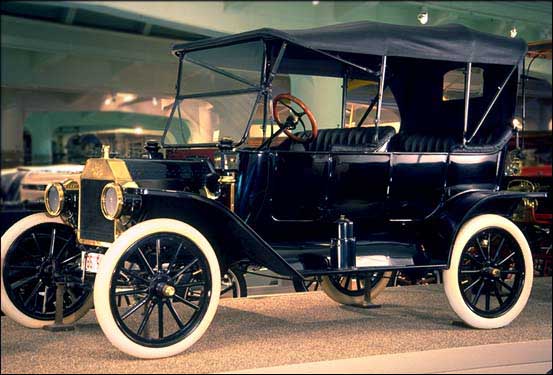
Automobile with One-man Canopy Top: Image courtesy of "The Henry Ford", 2006.


