Covered
No other bridge is more romantic or more a hallmark of the rural Vermont landscape than the covered bridge. Beneath picturesque gable roofs and rustic wood sheathing, intricately engineered truss systems work to support the weight of the traffic passing through. A number of truss systems developed during the era of timber frame bridge construction that greatly improved the structural soundness. In order to protect the timbers from the harsh Vermont winters, they were covered with the distinctive walls and roof. The majority of Vermont's covered bridges were constructed between 1820 and 1905, and many were lost during the 1927 flood. Following is a discussion of the common covered bridge types.
Multiple King-Post Truss
Many early covered bridge builders expanded the simple king-post truss design of the open truss bridges. The multiple king-post truss was able to span moderate crossings, occasionally exceeding 100 feet.
Burr Arch Truss
Theodore Burr, from Massachusetts, patented a new timber truss design in 1806 and 1817 that would increase the span of covered bridges. Burr combined the multiple king-post trusses with hewn timber arches. The interior framing of a Burr arch truss is revealed in the image below.
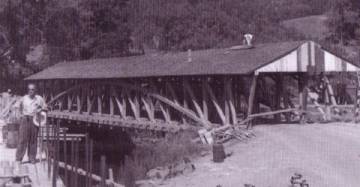
Burr Arch Truss: Image courtesy of Robert McCullough, Crossings: A History of Vermont Bridges, 2005
Town Lattice Truss
Ithiel Town, an architect from Connecticut, patented one of the most successful timber truss bridge designs in 1820. Town's design employs a cross-web, or latticework, of diagonal timber planks. The majority of Vermont's remaining covered bridges are classified as town lattice trusses. The interior latticework is exposed behind the wall opening in the image below.
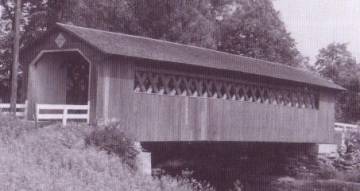
Town Lattice Truss: Image courtesy of Robert McCullough
Long Truss
Stephen H. Long received the first of many patents for bridge trusses in 1830. Long's truss system consisted of rectangular panels each with two diagonals crossing to form an X. Long's truss, exposed in the image below, never received as much acclaim as the trusses of Howe (discussed in the next paragraph) or Town.
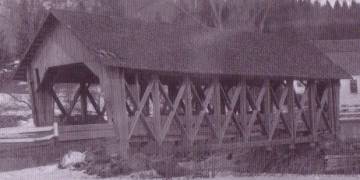
Long Truss: Image courtesy of Robert McCullough
Howe Truss
William Howe, a railroad engineer from Massachusetts, patented the most widely used 19th century bridge trusses in 1840 and 1846. Howe's design was quite similar to Long's, except Howe replaced the vertical timbers with iron beams. An example of Howe's truss is exposed on the double-span bridge below.
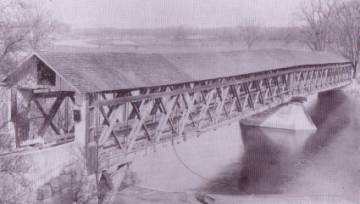
Howe Truss: Image courtesy of Robert McCullough
Paddleford Truss
Peter Paddleford, a timber framer from Littleton, New Hampshire, developed, but never patented, a timber truss design in the mid-19th century. Paddleford's design was also quite similar to Long's truss, except he combined short diagonals and elongated diagonals into each panel. A number of these bridges were constructed in Vermont.
Railroad Bridges
Railroad companies often used covered bridge designs for their crossings. What is notable, however, is that they increased the height of the traditional covered bridge design and added monitor roofs, allowing enough room for smoke and steam to escape. Eventually, around the late 1880s, railroad companies recognized the shortcomings of timber frame bridges, and they began constructing with iron.
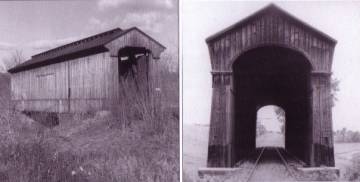
Railroad Bridges: Image courtesy of Robert McCullough


