Steel Beam and Girder
Like the reinforced-concrete beam and girder bridge, the steel beam and girder bridge is closely linked to the evolution of the automobile. Reinforced-concrete and steel were in competition during the 20th century, and reinforced-concrete was still favored over steel until the mid-1930s. The American Association of State Highway Officials (AASHO) formed in 1938 and set standards for highway bridge design. Spans became longer, roads became wider, and bridges were overall larger and higher. Steel, thus, was the most efficient means for meeting the guidelines of the AASHO. The widespread use of steel beam and girder marks the beginning of large-scale bridge projects in Vermont. Steel beam and girder bridges can be broken down into several categories, discussed below.
Iron and Steel Plate-Girder Bridges
Railroad engineers introduced steel plate-girder bridges before 1850. As steel technology developed in the 1890s, many Vermont railroads built through girders and deck girders. During the 1920s, many plate-girder bridges, mostly deck girders, were built along highways. This bridge type continued to be construction after WWII and into the early 1960s. A typical railroad through girder is seen in the image on the left, while a highway deck girder is seen in the image on the right.
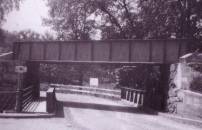
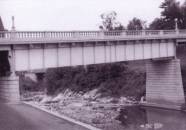
Plate-Girder: Image courtesy of Robert McCullough, Crossings: A History of Vermont Bridges, 2005
Iron and Steel Riveted-Girder or Rolled-Beam Bridges
Very simple beam bridges of iron or steel, consisting of a series of beams supporting a deck, were constructed heavily throughout rural Vermont. The earliest ones were probably assembled with rolled-iron railroad rails. Rails were then held in place by the stone abutments. Stones were likely placed across the rails to form a make-shift deck, which was then covered in gravel or clay. This simple bridge-type was probably common for small spans after the Civil War and into the earliest years of the 20th century.
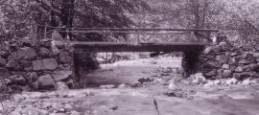
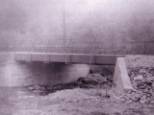
Simple Rolled-Beam: Image courtesy of Robert McCullough
Steel I-beams and vaulted reinforced-concrete deck
This rarer bridge type consisted of I-beams extending between abutments and arched metal forms placed between. Concrete was then poured over the arches.
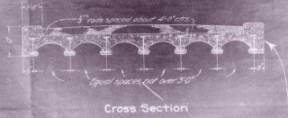
Vaulted: Image courtesy of Robert McCullough
Standard Simple-Span Rolled I-Beam Bridges
This bridge type gained popularity during the early 1920s and was quite common by 1925. Simple rolled I-beams span from one abutment to another, with a reinforced-concrete deck on top. This type was standardized in Vermont after the 1927 flood, and a great number were built between 1928 and 1929. Its popularity continued to grow during the 30s and peaked with the construction of the interstate system in the late 1950s and 1960s. The two images on the top are typical examples of the simple-span rolled I-beam bridge, but the image on the bottom is a more unique, artistic example.
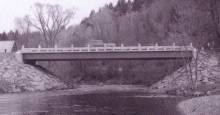
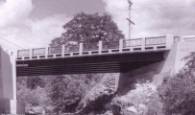
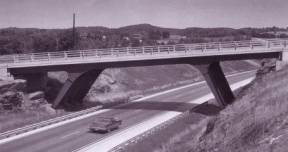
Standard Simple-Span Rolled I-Beam: Image courtesy of Robert McCullough
Pipe Railings
Standard plans for pipe railings were formulated in 1941. Two round pipes were placed horizontally with pipe spindles in the space between.
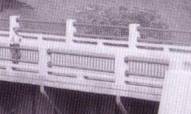
Pipe Railings: Image courtesy of Robert McCullough
Continuous-Girder Bridges
The continuous-girder bridge is a very common "simple span" bridge, meaning it is supported only at each end. Steel beams or girders were able to span three or more points of support. Construction was very cost-effective and efficient and well-suited for substantially longer bridges. It became quite popular after 1940 and was used extensively during the interstate construction of the late 1950s and 1960s.
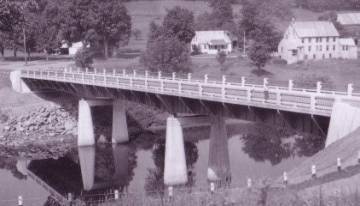
Continuous-Girder: Image courtesy of Robert McCullough


