Detached Garages
Initially, it was undesirable for one to have the garage close to the house. The grease and dirt of the automobile remained at a safe distance. Early drivers often placed their vehicles in their defunct carriage barns, while others constructed new garages at the rear of their premises. These early garages were typically small, squat gable or flat-roof structures with hinged double doors. Occasionally architectural details matched the house. The detached garage was the dominant type of the 1900s and 1910s. A number were still constructed into the 1920s. The detached garage continued to be built in small numbers throughout the first half of the 20th century, but it was no longer dominant after the 1920s.
The size of the garage below is typical of an early detached garage. Generally, there were no secondary doors and no room for storage space or additional vehicles. (The overhead door, however, was later invention.)
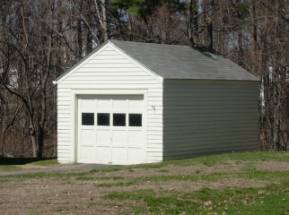
Small, Detached Garage: Image courtesy of Elizabeth André
Early garage doors were hinged, like those in the images below.
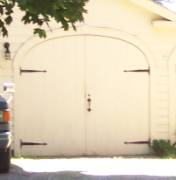
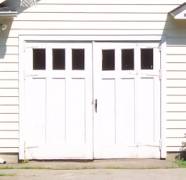
Hinged Doors: Image courtesy of Elizabeth André
Occasionally, early garages were built right up against the carriage barn. Many simple, flat roof brick structures, like the one in the image below, can be found in the rear of old houses. (Once again, the overhead door is a later feature.)
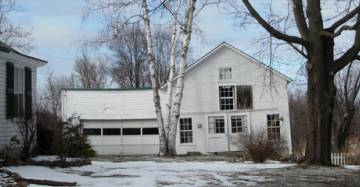
Garage Attached to Carriage Barn: Image courtesy of Elizabeth André


