Federal Blocks (pre-1830s)
The first commercial buildings constructed in Vermont were relatively modest in size and detail. These pre-1830s structures were usually eaves-front oriented with a stepped or sloping parapet wall and tall chimneys on the gable ends. Small six-over-six windows with splayed brick lintels opened into the brick or wood façade, and the windows on the upper story often closely abutted the eaves. There were no large plate glass windows on the first floor, like we see today, and generally there was little ornament. A simple porch may be found at the street level.
Several Federal style buildings can be seen in the view of the commercial district below. Specifically note the small size of the windows, the upper story windows that are close to the eaves, the end chimneys, and the sloping, eaves-front roofs. A few of the buildings also have simple porches.

Early Commercial Block: Image courtesy of the University of Vermont Landscape Change Program and the University of Vermont Special Collections
When one building stands alone, the parapet gable end, which occasionally boasts an elliptical fanlights, is visible, but often these buildings are constructed side by side. In this case, you can identify the gently sloping roof line or sometimes see the top of the parapet wall extending past the rooflines. Notice the parapet wall on the end of the building in the image on the left. It is very distinguishable. In the image on the right, notice the end chimneys rising above the roofline on the sloping roofed, eaves-front building.
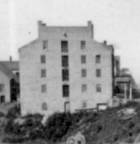
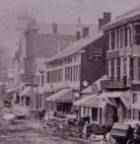
Parapet Walls: Image courtesy of the University of Vermont Landscape Change Program and the Fletcher Free Library. Image courtesy of the University of Vermont Landscape Change Program and the Vermont Historical Society.
Although most Federal style commercial buildings are relatively modest, they do vary from being short and narrow with no ornament to being taller and wider with some simple details. Larger, more elaborate buildings usually indicate a later date. And, as all styles tend to overlap from era to era, it is likely to see the beginning of the Greek Revival style around the 1830s. These transitional buildings may include larger windows with rectangular granite lintels.
The building in the image below is a bit larger than some of the earliest commercial blocks. The massing is still the same, and the windows are still small, but the façade is a little more elaborate and Greek Revival style rectangular lintels appear above the windows.
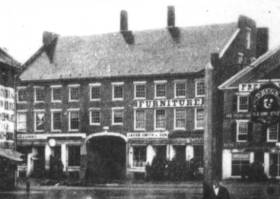
Federal and Greek Revival Commercial Block: Image courtesy of the University of Vermont Landscape Change Program and the Vermont Historical Society


