Window Displays
By WWI, the window display became an important vehicle for conveying the goods and services provided within the business. Throughout the 1910s, large plate glass windows became crowded with products and signs. Storefront entryways were often recessed, allowing additional window space for display. In the 1920s, window displays were simplified around a few main products or one attention grabbing item around which a sales pitch was formed. Window trimmings, painted window signs, transparent appliqués, and lettered placards placed behind the glass decorated storefront displays. The 1920s also saw the invention of the mannequin.
Notice the mannequin and the assortment of goods in the display window of the image below.
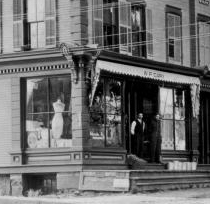
Window Display: Image courtesy of the University of Vermont Landscape Change Program and the Vermont Historical Society
Notice the recessed entrance, trimmings around the windows, and the simplified display in the image below.
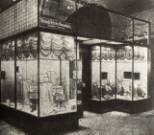
Window Displays: Image courtesy of John A. Jakle, Signs in American's Auto Age: Signatures of Landscape and Place, 2004


