Timber Dams
Many dams were constructed during the 18th and 19th centuries in Vermont, primarily adjacent to direct-drive water-powered mills. Timber crib dams and plank dams were common at this time. The crib dam was constructed of heavy timbers stacked like a log house and filled in with earth or rubble. Plank dams consisted of a series of wood planks laid side-by-side to create a sloping wall. Timber dams were rarely constructed during the 20th century, and many existing dams were washed away in the flood waters of 1927.
Below are a few examples of timber crib dams.

Timber Crib Dam: Image courtesy of the University of Vermont Landscape Change Program and the Hartford Historical Society
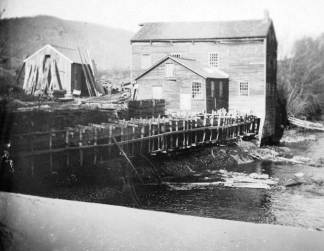
Timber Crib Dam: Image courtesy of the University of Vermont Landscape Change Program and the Vermont Historical Society
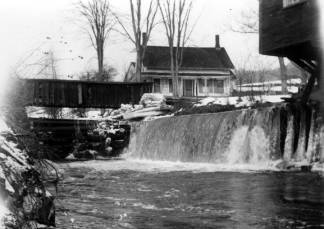
Timber Crib Dam: Image courtesy of the University of Vermont Landscape Change Program and the University of Vermont Archives, Collamer Abbott Collection
Below are a few images of timber plank dams. Note the sloping wall over which the water runs. The image on the bottom illustrates the construction of the planks.
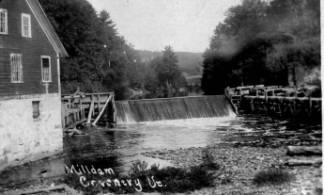
Timber Plank Dam: Image courtesy of the University of Vermont Landscape Change Program and the University of Vermont Special Collections
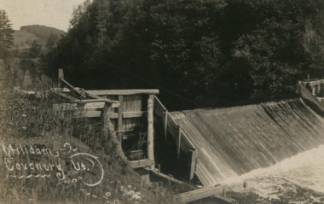
Timber Plank Dam: Image courtesy of the University of Vermont Landscape Change Program and the Old Stone House Museum
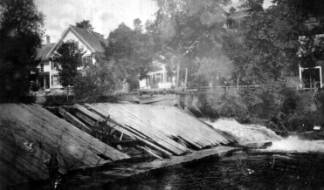
Timber Plank Dam: Image courtesy of the University of Vermont Landscape Change Program and the University of Vermont Special Collections


