Greek Revival
During the mid-19th century, the Greek Revival style dominated the architecture trends in Vermont. The order, proportion, and symmetry, along with the Classical forms, created a monumentality deserving of important public institutions. The buildings in the images below display a number of characteristics that distinguish the style.
Note on the image below the heavy columns supporting the entablature and pediment of the entry pavilion, the pilasters (flat or corner columns) supporting the entablature of the roof, and the well-proportioned dome in the center.
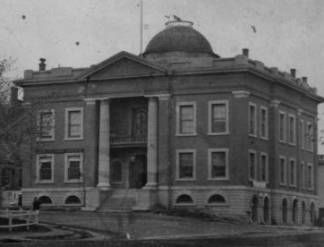
Greek Revival City Hall: Image courtesy of the University of Vermont Landscape Change Program and the University of Vermont Special Collections
Note in the image below the full pediment roof, which rests upon an entablature and pilasters, the rectangular stone lintels atop the windows and door, and the domed tower.
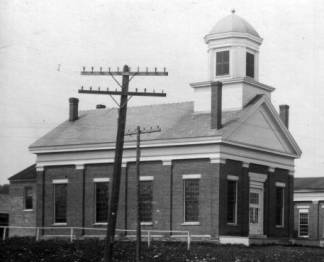
Greek Revival Town Hall: Image courtesy of the University of Vermont Landscape Change Program and the Williston Historical Society
Note in the image below the full pediment roof and entablature resting atop the heavy columns of the pavilion, the modillions (small, rectangular projections beneath the cornice), and the flat pilasters on the side wall.
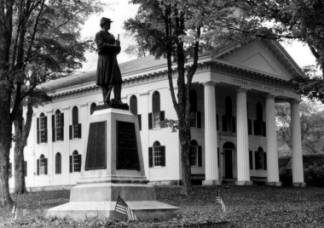
Greek Revival Court House: Image courtesy of the University of Vermont Landscape Change Program and the Vermont State Archives
Note in the image below the corner quoins (the heavy stones at the corners) and the pediments atop the windows.
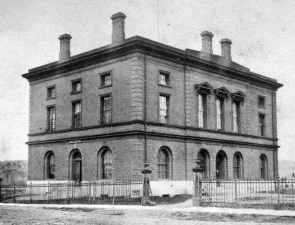
Court House and Post Office: Image courtesy of the University of Vermont Landscape Change Program and the University of Vermont Special Collections


