Powering the Engines
The type of fuel used to power the locomotives changed a number of times in an attempt to provide faster, cleaner, and more efficient service. The type of fuel effected the design of the locomotives and effected the type of structures erected along the tracks.
Wood
The first engines in Vermont were fueled with wood. Wood was the dominant fuel during the first 40 years of the railroad, and many lines of the Central Vermont Railway ran on wood into 1892. A car behind the engine carried the wood that was burned to fuel the train. Every 30 miles, trains needed to stop at wood sheds along the tracks to "wood up."

Wood Burning Engine: Image courtesy of Robert C. Jones, The Central Vermont Railway: A Yankee Tradition, 1981
Coal
During the early days of the railroad, only anthracite, or stone coal, was mined in the U.S., and this hard coal was very difficult to burn. Eventually a softer coal was mined, and by the 1860s and 1870s, coal was accepted as the best fuel for trains. The conversion from wood to coal began in Vermont around 1880 and was complete by 1892, with the bulk of the conversions taking place between 1884 and 1886. Coal was carried in a car behind the engine, and coal plants were constructed along rail lines. By 1890, passenger trains were equipped with steam heat. The last steam-powered engines were acquired by the Central Vermont Railway in 1928; however, steam engines were still used in the subsequent decades, only in smaller numbers.
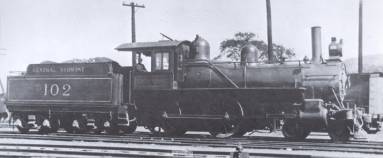
Coal Burning Engine: Image courtesy of Robert C. Jones
Electricity
During the late 1890s and into the 1920s, many smaller trolley lines and interurban lines were running on electricity. On the main lines, several gas-electric cars were acquired in the 1920s. The steam locomotives were still the most common type of engine at this time.
Diesel
The diesel or diesel-electric engine became a popular alternative to the steam engine after WWII. Diesel was more efficient and cleaner than coal. The first diesel-electric engine appeared in Vermont in 1941.


