Italianate
This elaborate Victorian era style gained popularity in Vermont in the 1860s and 1870s. Although the distinctive cupola often characterizes the Italianate style, many structures do not have cupolas. However, many other Italianate details are easily identifiable and can be found on both high and low-style structures. The Italianate style derive its design from the elaborate villas of the Italian Renaissance.
The image on the left illustrates a low-style, vernacular Italianate structures. Although very simplified in comparison to the high-style example on the right, the vernacular structure features many common Italianate details.
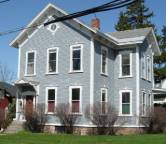
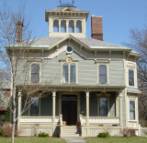
Vernacular Italianate and High-Style Italianate: Images courtesy of Elizabeth André
The following details are common to the average Italianate style house. The low-style, vernacular Italianate structures typically feature only a few character-defining details, but those details are easily identifiable.
Cube Shape

Image courtesy of Elizabeth André
Cupola

Image courtesy of Elizabeth André
Brackets Beneath the Cornice, Usually in Pairs

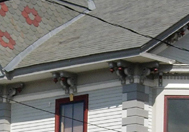
Images courtesy of Elizabeth André
Flat Roof or Shallow Hipped Roof

Image courtesy of Elizabeth André
Wall Gable
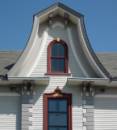

Images courtesy of Elizabeth André
Elaborate Window Molding, Usually with a 2-Over-2 Window Sash (the window on the right is likely a replacement 1-over-1 sash; the original would have been 2-over-2)
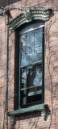
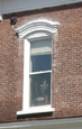
Images courtesy of Elizabeth André
Bracketed Door Hood
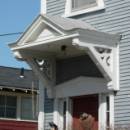
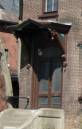
Images courtesy of Elizabeth André
Round Window, Particularly within a Gable Peak
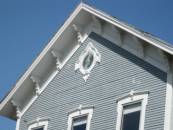
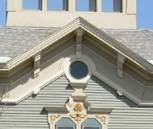
Images courtesy of Elizabeth André
Bay Window

Image courtesy of Elizabeth André
Front or Side Porch, Usually with Squared Posts and Brackets

Image courtesy of Elizabeth André
Tower with Flat Roof or Mansard Roof (flat top with steep or flared sides)
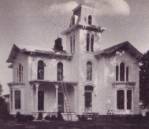
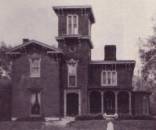
Images courtesy of Virginia and Lee McAlester, A Field Guide to American Houses, 2004


