Drive-In Movie Theatres
The idea for the drive-in movie theatre was conjured up in the early 1930s by Richard M. Hollingshead, Jr, of New Jersey. During the Great Depression, people were reluctant to part with their automobiles, and movies kept them entertained. Hollingshead combined the two and patented his outdoor theatre in 1933. These new theatres were located in a field near a highway, had a large screen shielded by a wind-resistant screen house or screen tower, a series of ramps encircling the screen in a semi-circle, onto which customers would drive their vehicles, and a projection booth. The first drive-in theatre opened in Camden, New Jersey, in 1933. Camden, New Jersey's drive-in is pictured on the left, and another early drive-in, in California, is pictured on the right.
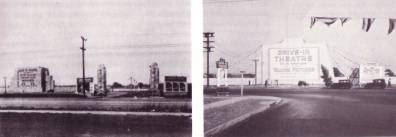
Early Drive-In Theatres: Image courtesy of Chester H. Liebs, Main Street to Miracle Mile, 1995
The interior field of the drive-in was very utilitarian and did not need architectural ornament to draw customers. The exterior, however, was visible from the highway and required an aesthetically pleasing, if not showy, façade. Beginning in the 1930s, drive-in theatre owners borrowed the glitzy designs of traditional downtown theatres.
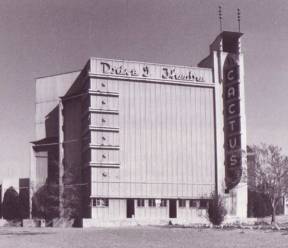
Art Deco Drive-In Theatre: Image courtesy of Chester H. Liebs
The growth of the drive-in theatre industry was slow in the coming years. Not until after WWII did a boom in drive-in theatres hit the nation. Thousands of fields across the nation filled up with the large screens and scores of poles that characterized the drive-in. Many owners even installed a number of additional attractions, such as kiddie playgrounds, picnic benches, and shuffleboard courts, and swimming pools, to lure movie patrons and their children.
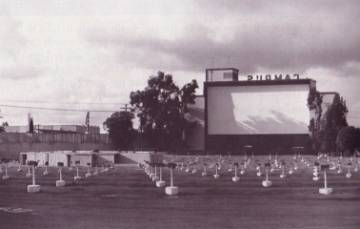
Drive-In Theatre Interior: Image courtesy of Chester H. Liebs
During the 1940s and 1950s period of expansion, many drive-in owners quickly constructed very inexpensive, make-shift buildings. Additionally, a number of eye-catching gimmicks were added to the exterior of the drive-in. The image below illustrates the Gratiot drive-in in Detroit that featured a waterfall cascading down the façade.
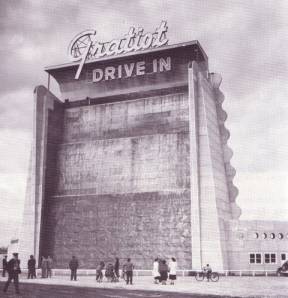
Gratiot Theatre Waterfall: Image courtesy of Chester H. Liebs
The signboard also became an important feature in luring customers during the post-war boom. A number of attractions were displayed on the board, much like the traditional theatre marquee.
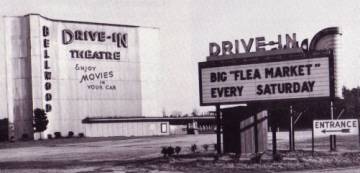
Drive-In Theatre Signboard: Image courtesy of Chester H. Liebs
The introduction of Cinemascope in the 1950s allowed drive-in owners to install much large screens. Many existing drive-ins were expanded. The images below provide two views of the same drive-in before and after the enlargement of the screen.
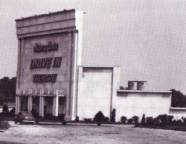
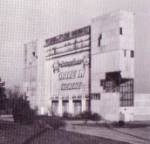
Cinemascope Expansion: Image courtesy of Chester H. Liebs
Drive-in theatres reached their peak in 1958, but have been on a gradual decline ever since. A number of gimmicks in the 1960s attempted to revive the drive-in theatre. A Brattleboro, Vermont, drive-in owner erected a motel within full view of his theatre, and each roof was outfitted with a speaker. By the 1970s, the old theatres began to decay.


