Motels
During the 19th century, hotels were located in downtowns or near railroad stations. Even at the beginning of the 20th century, few places existed along the roadside for travelers to spend the night. Motorists camped along the roadside wherever they could. Eventually, after WWI, landowners objected to the litter, noise, and pollution of unregulated camping of tourists. As a result, many communities established municipal tourist camps, often near downtown business districts, as seen in the image below. Competition between neighboring towns prompted communities to provide a number of amenities for their tourists, such as picnic tables, fireplaces, flush toilets, showers, eating shelters, recreation areas, and electrical hookups.
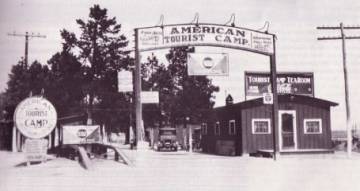
Tourist Camp: Image courtesy of Chester H. Liebs, Main Street to Miracle Mile, 1995
The tourist camp, however, faded away during the mid-1920s. Lower-priced automobiles allowed a surge of new tourists. The more affluent motorists began to reject the campgrounds, and communities grew concerned over the type of travelers that may show up in town. Many communities opted to begin charging motorists to stay in their campgrounds, prompted private home owners to compete with the campgrounds by opening their spare rooms for lodging or allowing campers on their land. These private enterprises spelled the downfall for the public tourist camp. The evolution of the private campground was the motor court, seen in the images below. By the 1930s, small cabins were neatly arranged in parallel rows, crescent-shapes, L-shapes, or U-shapes.
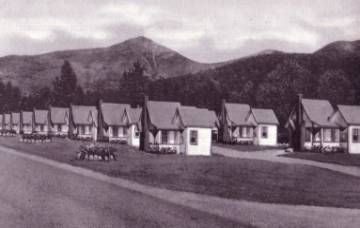
Motor Court: Image courtesy of Chester H. Liebs
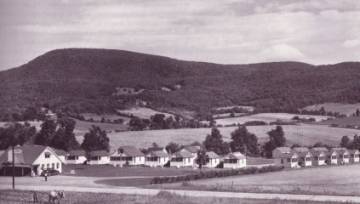
Motor Court: Image courtesy of Chester H. Liebs
During the late 1920s and 1930s, the exterior imagery became a significant feature, as it would draw tourists from the road. Many had the look of quaint, residential cottages, while others boasted more unique themes, like the windmill seen in the image below.
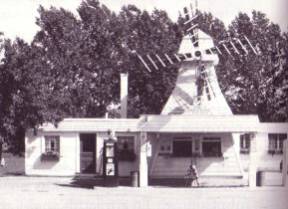
Dutch Themed Motor Court: Image courtesy of Chester H. Liebs
During the 1930s, in the midst of the Great Depression, motel proprietors abandoned the traditional building motifs and embraced Modernism. With its smooth, rounded curves, shiny surfaces, and machine aesthetic, the Streamline Moderne style, seen below, answered the needs of a society looking into the future.
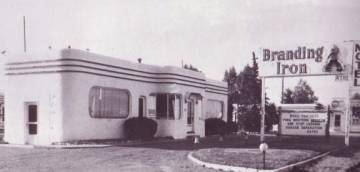
Streamline Moderne Motel: Image courtesy of Chester H. Liebs
In the post-WWII years, the individual motor court cabins gave way to the single motel building that we know today. Strings of rooms were placed in one long, low building. As well, the architectural motifs of the previous decades were abandoned in favor of simple, inexpensive, utilitarian designs, seen in the images below. Flat-roofed, rectangular, brick and concrete block buildings with a simple neon "Motel" sign began sprouting up along the roadside.
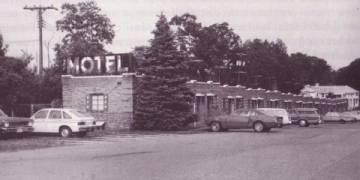
Post-WWII Motel Design: Image courtesy of Chester H. Liebs
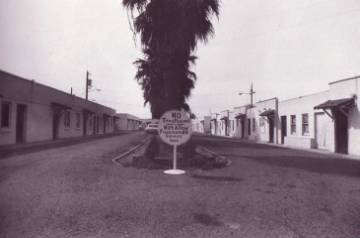
Post-WWII Motel Design: Image courtesy of Chester H. Liebs
During the 1950s, chains and franchises began popping up alongside the small, privately owned motels.
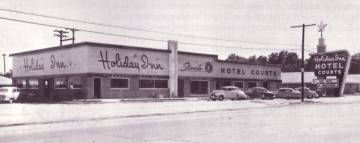
Chain Motel: Image courtesy of Chester H. Liebs
In order to quickly and inexpensively expand their businesses, chains adopted the "center-core" construction, seen in the image below. One or more floors of rooms were arranged back to back along a utility core (electrical lines, plumbing etc.), and bathrooms were grouped together at intersecting corners. The doors and windows opened to outdoor, circumferential walkways.
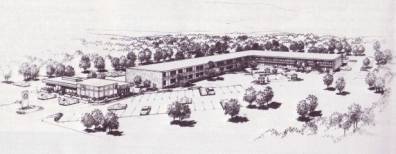
Center-Core Motel Design: Image courtesy of Chester H. Liebs
By the late 1950s, many chains constructed mid-rise motels with interior corridors and elevators. These new businesses also provided a number of amenities, such as restaurants, meeting rooms, indoor pools, and lobbies, that were more characteristic of hotels than motels. The word "motel" itself gradually fell out of favor and was replaced by the "highway hotel" or merely "hotel." A sleek, late 1950s hotel in the Exaggerated Modern style is seen in the image below.
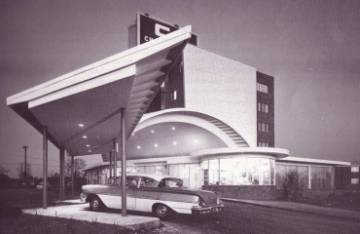
Exaggerated Modern Hotel: Image courtesy of Chester H. Liebs


