Visual Characteristics
Utility lines have changed very little in appearance over the past century, but there are some clues in their construction that one can use to determine a relative time period.
Prior to the introduction of electricity in the late 1880s and 1890s, telephone lines alone crossed the streetscape. There were fewer poles needed and fewer wires connecting them. The poles were thin and roughly cut. Usually only one horizontal member, to which the wires were attached, was attached at the top. The late 1870s and early 1880s images below illustrate these early telephone lines.
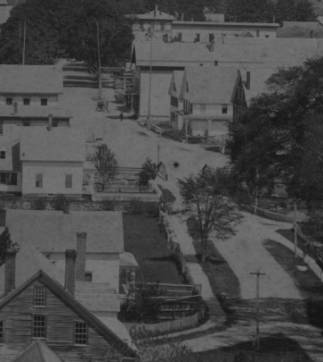
1870s-1880s Telephone Poles: Image courtesy of the University of Vermont Landscape Change Program.
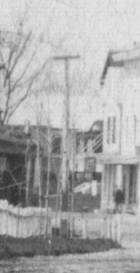


1870s-1880s Telephone Poles: Images courtesy of the University of Vermont Landscape Change Program.
During the late 1880s and into the early 1900s, as electricity spread through cities and villages of Vermont, more utility poles were erected and additional horizontal members were affixed to the tops of poles.
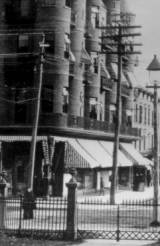
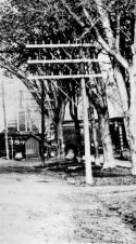
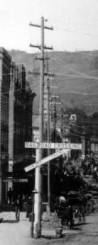
1880s-1900s Telephone Poles: Image courtesy of the University of Vermont Landscape Change Program.
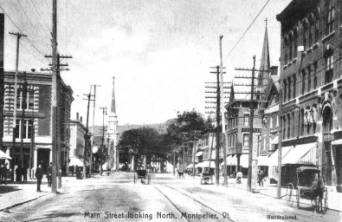
1880s-1900s Telephone Poles: Image courtesy of the University of Vermont Landscape Change Program.
By the 1910s and 1920s, commercial centers became a hodgepodge of poles and wires. Poles were still roughly cut and an assortment of horizontal members of varying sizes were mounted at the top. As well, transformers began to appear on utility poles around the 1910s. The transformers are the metal boxes mounted near the top of the pole that help to transmit power.
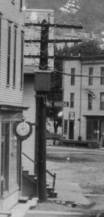
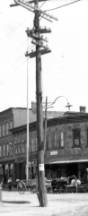
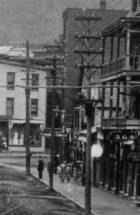
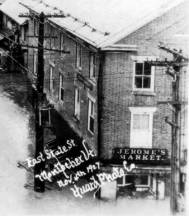
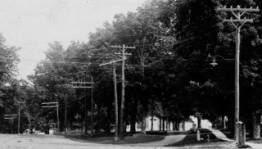
1910s-1920s Telephone Poles with Transformers: Images courtesy of the University of Vermont Landscape Change Program.
Note the chaos of wires crossing the streetscape in the image below.
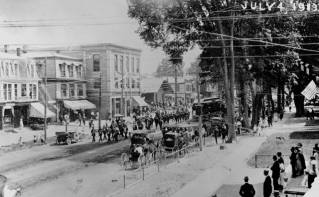
1913 Street Scene: Image courtesy of the University of Vermont Landscape Change Program.
During the 1930s, power lines spread across rural areas. These new poles were more uniformly constructed, as seen in the images below.

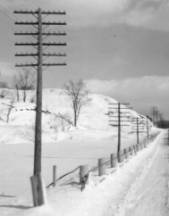
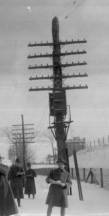
1930s Rural Telephone Poles: Images courtesy of the University of Vermont Landscape Change Program.
Beginning in the 1930s, many of the poles and wires in cities and villages were improved and consolidated or placed underground. Notice in the image below how the utility lines have been uniformly constructed and consolidated to one side of the road.
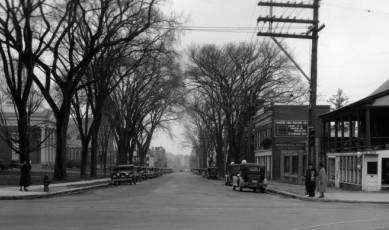
Improved Telephone Poles: Image courtesy of the University of Vermont Landscape Change Program.
Notice the absence of utility lines in the image below.
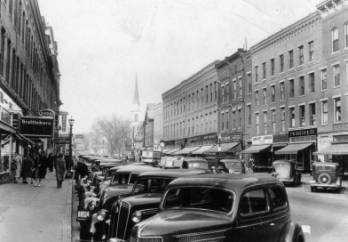
Absence of Utility Lines: Image courtesy of the University of Vermont Landscape Change Program.


