Early Box
In the late 1910s and early 1920s, drive-in filling stations began to spread throughout America's downtowns. During this time, the City Beautiful movement was well underway. In order to integrate these new, obtrusive structures into built environment, they needed to display civic pride. Although these early drive-in stations were small, they incorporated attractive architectural details and landscaping features that reflected the City Beautiful ideals. Common to the stations of this time period were small rooms used for storage of supplies and equipment and large, flat, rectangular canopies supported by one or two posts. Architectural details varied but generally possessed a grandeur not found in gas stations of the present day. The images below exemplify some of the qualities of these early box stations of the City Beautiful movement.
The image below illustrates an early box station, provided with a small storage room and a canopy supported by a single post. Notice that the room is only large enough for the storage of supplies and that although the design is simple, the canopy displays decorative moldings at the corners and the window of the storage room are divided into small panes.
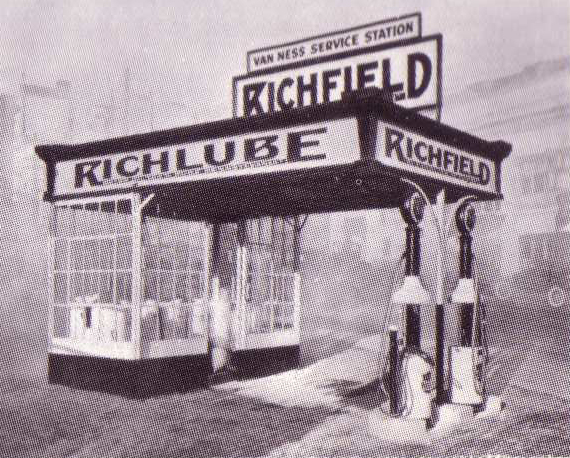
Early Box Station: Image courtesy of Chester Liebs, Main Street to Miracle Mile: American Roadside Architecture, 1985.
The image below illustrates another early box station. Note the columns supporting the brick canopy, the multi-paned windows, and the ornamental light fixture.
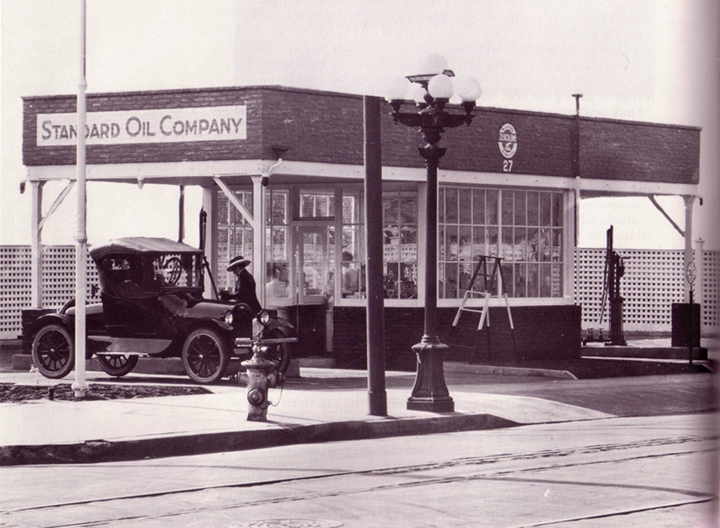
Early Box Station: Image courtesy of Chester Liebs.
The image below reflects the architectural details of the many brick commercial buildings populating American main streets. Note the heavy, brick columns supporting the canopy and the details along the roofline.
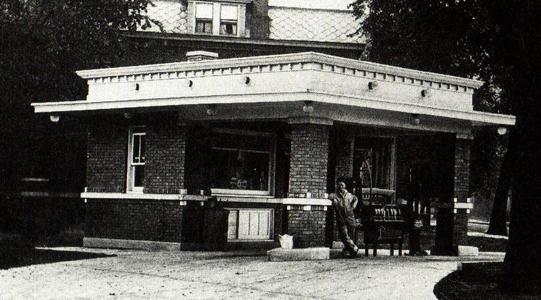
Early Box Station: Image courtesy of John Jakle, Gas Station in America, 1994.


