Pre-Fabricated House
As drive-in filling stations replaced curbside pumps in the 1920s, the new structures sought to assimilate with the existing environment. More and more, gas stations moved into residential neighborhoods. In order to preserve the character of the neighborhood, oil companies designed their filling stations to reflect popular house styles. These pre-fabricated structures took on a number of styles, including the bungalow, Colonial Revival, and Tudor Revival. Grounds were often landscaped, and flower boxes were placed in windows. Early house style stations had canopies, but the canopies were removed in the late 1920s to free up space for cars to drive through. The images below provide only a small sample of the types of house style stations constructed during this time period.
The image below illustrates a gas station designed to resemble a Colonial style house. This design was constructed throughout New England, referencing the popular architectural styles of the region.
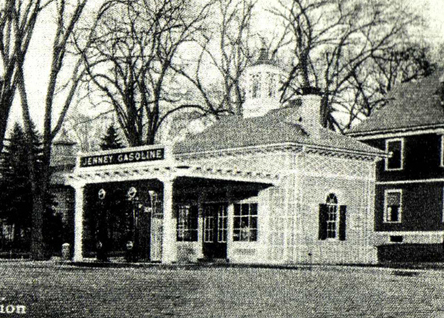
Colonial Style Station: Image courtesy of John Jakle, Gas Station in America, 1994.
The image below illustrates another example of a house style gas station with attached canopy. This small station with a low, overhanging hipped roof references the bungalow, a popular house style of the 1920s.
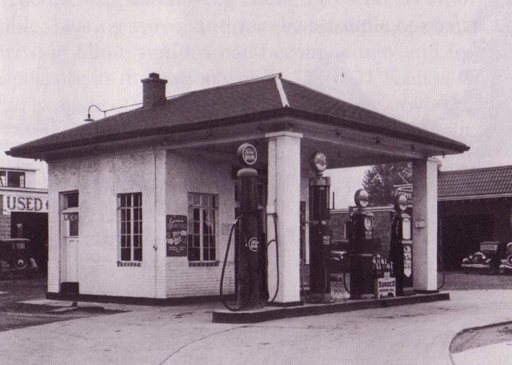
Bungalow Style Station: Image courtesy of Chester Liebs, Main Street to Miracle Mile, 1985.


