Early Wood Burning (1840s-1870s)
The wood burning engines of the Vermont railroads were generally constructed from the late 1840s, at the advent of the railroad, through the 1870s. A large number were constructed during the 1850s, and they continued to run through the 19th century. These wood burning engines can easily be identified, as they feature a number of recognizable details.
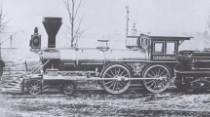
Railroad engines are characterized by their wheel arrangement. Most early engines had two sets of wheels: the truck wheels and the driving wheels. The truck wheels were a small set of wheels at the front of the engine the pivoted on an axel to steer the vehicle. The driving wheels were a larger set of wheels at the rear of the engine that were powered to move (drive) the vehicle. The most common engine type from the 1840s to the 1870s was the 4-4-0, also called the "American type." There were 4 truck wheels (two on each side), 4 driving wheels (two on each side), and no wheels behind the driving wheels. As seen in the image below, the wheels of these early wood burning engines were in the 4-4-0 arrangement, the driving wheels were quite large, and the main rod was connected to the driving wheels. Also note the fairly simple mechanics of the wheels.
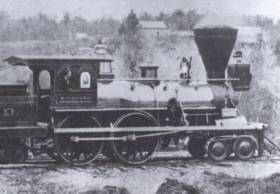
1852 Engine: Image courtesy of Robert C. Jones, The Central Vermont Railway: A Yankee Tradition, 1981
Another very distinguishing feature of the early engines is the large, funnel-shaped smokestack. Most of the smokestacks took on the tapered form seen in the image on the left, while a few had a straight stack with a smaller funnel shape at the top, seen in the image on the right.
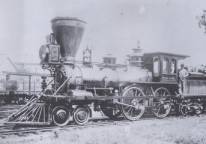
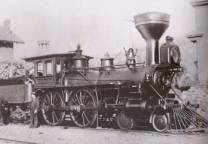
1854 and 1852 Engines: Image courtesy of Robert C. Jones
As seen in the image on the left, most of the early engines had a very short wheel base for the truck wheels. Later engines of the 1860s or 1870s had a broader truck wheel base, seen in the image on the right, which is identifiable by the large gap between the first and second truck wheels. This change is due to the location of the boiler. Also note how the earlier engine on the left is more compact, while the later 1860s engine on the right is elongated.
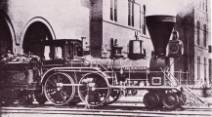
1852 and 1866 Engines: Image courtesy of Robert C. Jones
Other distinguishing features to note are the large square headlight placed in front of the smokestack, the prominent grille protruding in front of the truck wheels, the long, tubular form of the body, and the small cabin at the rear of the engine. A car of wood, used for fuel, was attached to the rear of the engine.
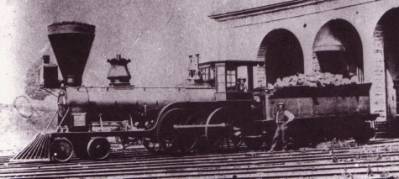
1850 Engine: Image courtesy of Robert C. Jones
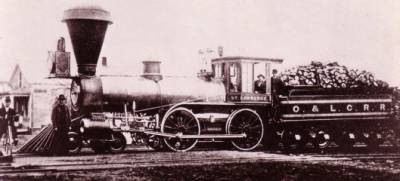
1849 Engine: Image courtesy of Robert C. Jones
Although most engines prior to the 1880s were 4-4-0s, a new type was introduced in the 1870s. "The Mogul," or 2-6-0 engine, gained more popularity during the 1880s, but an 1870s example can be seen below. Except for the 2 truck wheels and six driving wheels, all other details of this engine are the same as the earlier 1850s and 1860s engines.
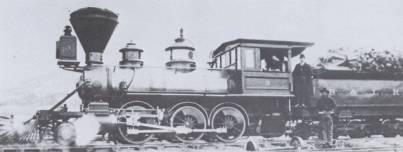
1877 Engine: Courtesy of Robert C. Jones


