Post-Medieval English
This Colonial Revival subtype, popular from the 1930s through the 1950s, is loosely based on the early Post-Medieval English style of the 17th century. The unifying characteristic of the style is the slightly overhanging second story, often with a masonry veneer on the lower story. Many 1930s examples feature decorative pendants beneath the overhang. This decorative elementwas rare by the 1950s. In addition to the second-story overhang, these structures usually featured eaves-front façades, multi-pane windows, and Classical door surrounds or entry porches.
The house in the image below features decorative pendants beneath the overhang. Otherwise, the structures is relatively unadorned, having only a simple pediment roof entry porch.
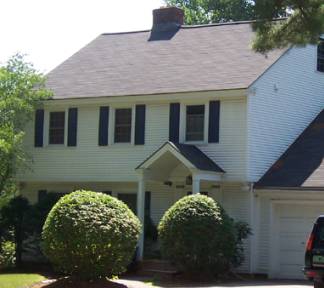
Post-Medieval English Colonial Revival: Image courtesy of Elizabeth André
The overhang on the house below is very slight but still noticeable. Also characteristic is the brick veneer of the first story. The Colonial Revival entry porch with round-arch pediment and columns adorns the façade.
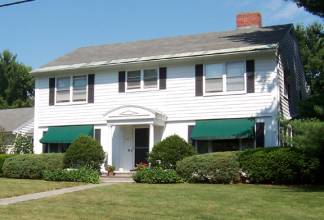
Post-Medieval English Colonial Revival: Image courtesy of Elizabeth André
The image below illustrates a later 1950s example. The overhang is prominent, along with the brick veneer. The structure has become more modest and features a large picture window, both typical of the 1950s.
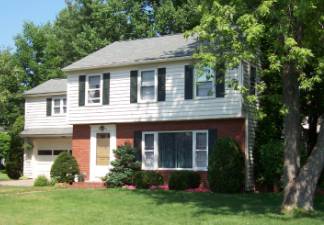
Post-Medieval English Colonial Revival: Image courtesy of Elizabeth André


