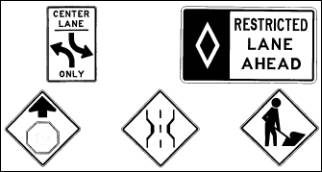
Traffic
As early as 1910, "look alike" traffic signs appeared. These signs were not officially standardized but designed to be easily recognizable. In 1914, the National Council for Industrial Safety broadened their scope to include traffic accidents. Urban streets became a chaotic mass of automobiles, trolleys, and carriages, and the subject of traffic regulation was being investigated. The first stop sign appeared in 1915 in Detroit, and warning signs appeared in 1919. The increased motor traffic required the need for safety at railroad crossings. In 1922, signals began to appear at crossings.
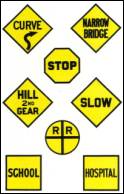
Main Streets and other commercial districts also began installing signs and signals to accommodate the increased automobile traffic of the 1920s. In 1927, the American Association of State Highway Officials (AASHO) published a uniform sign manual. The original set of standard signs were yellow with black lettering, as seen in the set on the left. The set of signs on the right were actually yellow and black, as well, but the images were printed in black and white. The set on the left were issued by the AASHO, and the set on the right were published in the Manual on Uniform Traffic Control Devices (MUTCD).
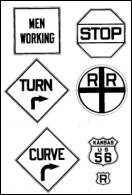
The following set of signs was published in the 1930 MUTCD.
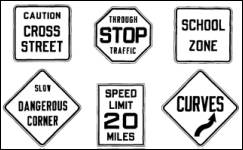
The following set of signs was published in the 1935 MUTCD. At this time the writing becomes minimized and symbols become more dominant. Also, note the reflectors on the stop sign. Reflectors came into use in 1931.

The following set of signs was published in the 1948 MUTCD. This time period also marks the change from the squared-off lettering of the previous decades to the rounded lettering that is used today.
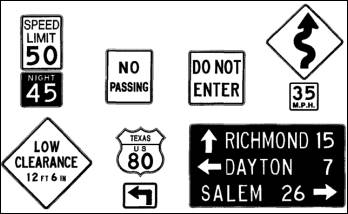
In 1954, the official color scheme for stop signs changed from yellow with black lettering to the red and white design still used today. The yield sign was also introduced with a yellow background and black lettering, seen below.

The following set of signs was published in the 1961 MUTCD. Notice how the additional words have been removed from the yield sign.
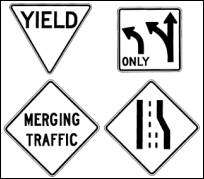
The following set of signs was published in the 1971 MUTCD. These signs, which are still seen today, largely exclude words and rely solely on symbols as a universal language.
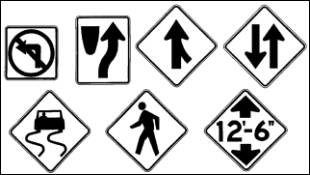
The following set of signs was published in the 1978 MUTCD. These signs are also used today.