U.S. Route
The American Automobile Association (AAA) formed in 1902, printing maps, placing road signs, and planning trips into the countryside. The Trail Association, a group of motor travel enthusiasts, unofficially named roads and placed signs. There were no standards, though, for signage. The Federal Highway Aid Act of 1921 allotted money for the construction of and improvement of federal highways, and the U.S. Route system was born. In 1924, the unofficial highway names were replaced with the standard U.S. route numbers used today. Odd numbered roads run north-south and even numbered roads run east-west. Odd numbered routes are laid out numerically from the East Coast to the West Coast, and even numbered routes are laid out numerically north to south.
The signs in the image below are not standard U.S. Route signs. These were likely placed around Vermont prior to the issuance of new signs, which is discussed in the next paragraph. Since this image, and many others with these signs, dates from the 1930s, it is likely that they were not immediately removed and replaced with the new, standard signs. The appearance of this type of sign in an historic Vermont image would imply a late 1920s to 1930s date.
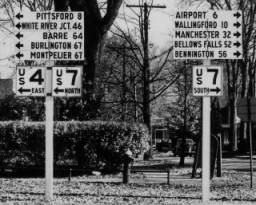
Old U.S. Route Signs Image courtesy of the University of Vermont Landscape Change Program and the Vermont State Archives
The new numbering system required a new set of standardized signs. U.S. route signs were given the black and white design still used today. As well, speed limit signs and other traffic signs were standardized for highway safety in 1926. The first signs were the black and white shields with the state name in the top portion and U.S. plus the route number in the lower portion. The signs were in the shape of a shield, as seen below, not on a square background. Small R and L signs, also shaped like shields, were placed below the signs to indicate direction; they were used into the 1930s. The lettering on the early U.S. Route signs was squared, not rounded.

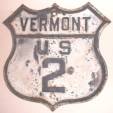
1926 U.S. Route Signs
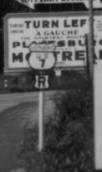
U.S. Route Sign with Directional "R" Sign: Image courtesy of the University of Vermont Landscape Change Program and the Vermont State Archives
In 1948, the National Manual of Uniform Traffic Control Devices (MUTCD) allowed the use of a shield on a white square background in addition to the cut-out shield design. More importantly, the squared lettering was changed to rounded lettering. An example from Oregon is seen below.

1948 U.S. Route Sign
In 1954, many of the eastern states developed a sign that removed the divider line between the state name and the U.S. number and incorporated them into one. For example, a sign in Vermont would read "U.S.-Vermont" at the top with the number below. It is unclear, though, whether Vermont used this design, which was very short-lived. An example from Ohio is shown below.

1954 U.S. Route Sign
In the mid-1950s, the MUTCD approved the removal of the state name and the U.S. from the shield, leaving only the number. This design was used along with the original design.
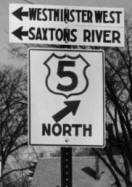
Mid-1950s U.S. Route Sign: Image courtesy of the University of Vermont Landscape Change Program and the Vermont State Archives
Today, most states, including Vermont, use the white shield on the black square background. Instead of the R and L used in the 1920s and 1930s, directional arrows are posted beneath the side.
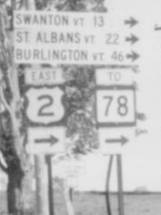
Directional Arrows: Image courtesy of the University of Vermont Landscape Change Program and the Vermont State Archives
In addition to the route number signs, look for other black and white signs posted along highways, including speed limit and directional signs. These supplementary signs were also introduced in 1926.
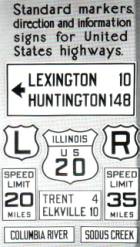
Standard Signs: Image courtesy of Dan McNichol, The Roads that Built America, 2003.


